Beyond Chatbots: Personalizing Customer Journeys with AI
* **Start Small, Scale Smart:** Begin with specific use cases where AI can deliver immediate value, such as automating FAQs or personalizing product recommendations, then gradually expand. * **Data is King:** Ensure you have clean, well-structured data to feed your AI models. The quality of your AI's personalization is directly tied to the quality of your data. * **Human-in-the-Loop:** AI should augment, not replace, human agents. Empower your human teams with AI insights and tools to handle complex, high-value interactions. * **Ethical AI:** Prioritize data privacy, transparency, and fairness in your AI implementations to build trust with your customers. * **Continuous Optimization:** AI models require continuous monitoring and refinement. Regularly analyze performance metrics and customer feedback to improve your AI-powered CX initiatives.
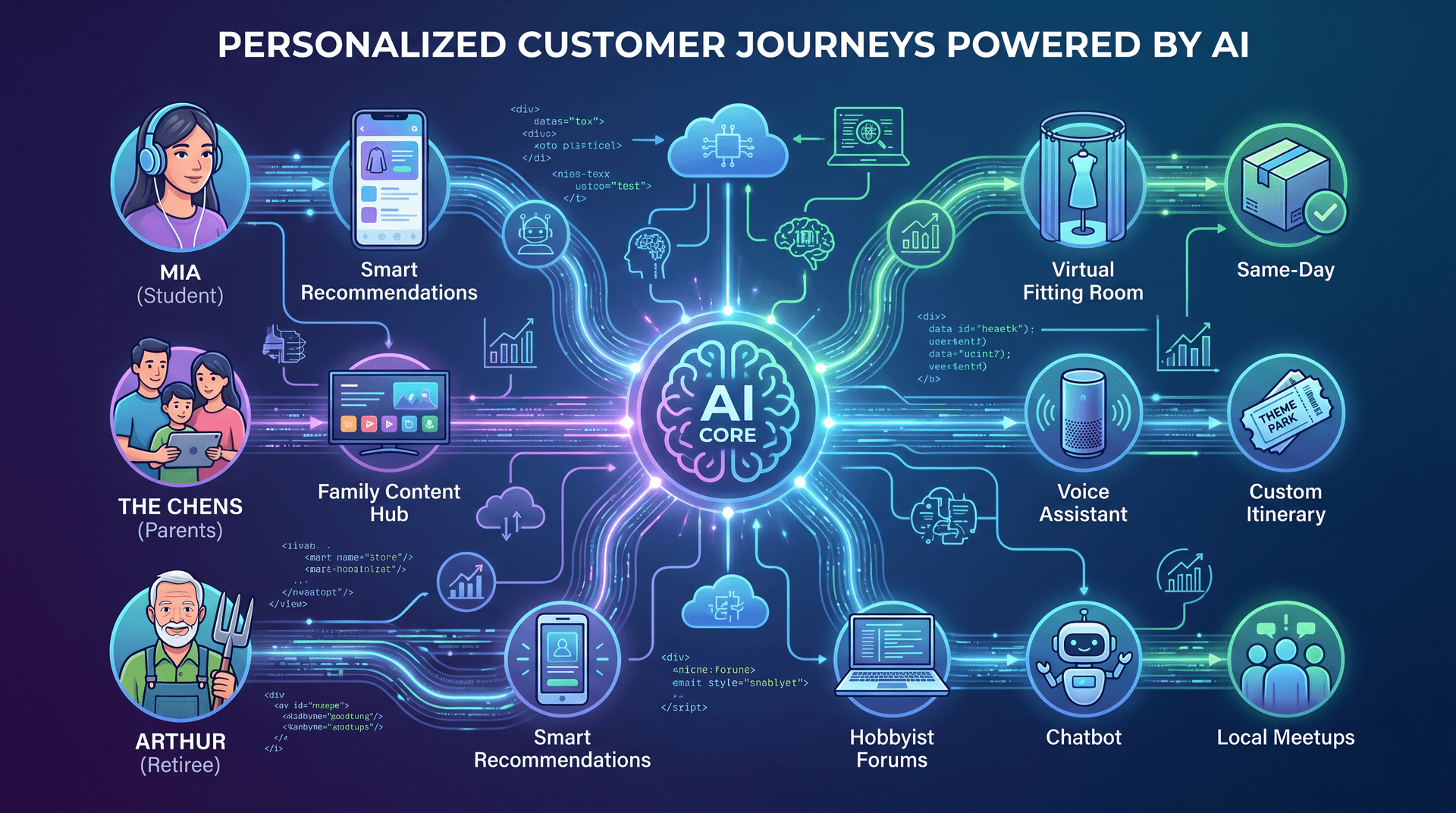
Beyond Chatbots: Personalizing Customer Journeys with AI
Introduction
In today's hyper-connected world, customer experience (CX) is no longer just a buzzword; it's a critical differentiator. As businesses strive to stand out, the traditional approach of one-size-fits-all customer service is rapidly becoming obsolete. Enter Artificial Intelligence (AI), a transformative force that is revolutionizing how companies interact with their customers. While chatbots have been a common entry point for AI in CX, the true power of AI extends far beyond automated conversations, enabling deeply personalized customer journeys that foster loyalty and drive growth.
The Evolution of Customer Experience with AI
For years, chatbots have served as the frontline of AI in customer service, handling routine queries and providing instant responses. While effective for basic support, they often fall short in delivering the nuanced, empathetic, and personalized interactions that customers now expect. Modern AI, however, is capable of much more. By analyzing vast amounts of data—including customer behavior, preferences, purchase history, and sentiment—AI can create a holistic view of each customer, allowing businesses to anticipate needs and tailor interactions proactively.
Key Pillars of AI-Powered Personalized Customer Journeys
1. Predictive Personalization
AI algorithms can predict customer needs and preferences before they even arise. By analyzing past interactions and behavioral patterns, AI can recommend products, services, or content that are highly relevant to individual customers. This proactive approach not only enhances the customer experience but also significantly boosts conversion rates and customer satisfaction.
2. Intelligent Virtual Assistants (IVAs)
Moving beyond rule-based chatbots, IVAs leverage natural language processing (NLP) and machine learning (ML) to understand complex queries, engage in more natural conversations, and even handle multi-step processes. They can seamlessly integrate with CRM systems, providing agents with real-time customer insights and even resolving issues autonomously, freeing human agents to focus on more complex cases.
3. Dynamic Content and Offerings
AI enables businesses to deliver dynamic content and personalized offers across various touchpoints. Whether it's a website, email, mobile app, or social media, AI can adapt messaging, visuals, and promotions in real-time to resonate with individual customer segments, ensuring maximum engagement and relevance.
4. Sentiment Analysis and Empathy
Advanced AI tools can analyze customer sentiment from text and voice interactions, allowing businesses to understand the emotional tone of conversations. This capability helps in identifying frustrated customers, escalating critical issues, and even guiding human agents on how to respond with appropriate empathy, leading to more positive outcomes.
5. Seamless Omnichannel Experience
Customers interact with brands across multiple channels. AI plays a crucial role in stitching together these disparate interactions into a seamless, unified customer journey. By maintaining context across channels, AI ensures that customers don't have to repeat themselves and receive consistent, personalized support regardless of how they choose to engage.
Implementing AI for Personalized CX: Best Practices
- Start Small, Scale Smart: Begin with specific use cases where AI can deliver immediate value, such as automating FAQs or personalizing product recommendations, then gradually expand.
- Data is King: Ensure you have clean, well-structured data to feed your AI models. The quality of your AI's personalization is directly tied to the quality of your data.
- Human-in-the-Loop: AI should augment, not replace, human agents. Empower your human teams with AI insights and tools to handle complex, high-value interactions.
- Ethical AI: Prioritize data privacy, transparency, and fairness in your AI implementations to build trust with your customers.
- Continuous Optimization: AI models require continuous monitoring and refinement. Regularly analyze performance metrics and customer feedback to improve your AI-powered CX initiatives.
Conclusion
The era of generic customer service is over. AI is empowering businesses to move beyond basic chatbots and create truly personalized, empathetic, and efficient customer journeys. By embracing AI, companies can not only meet but exceed customer expectations, building stronger relationships, fostering loyalty, and ultimately driving sustainable growth in a competitive digital landscape. The future of customer experience is personal, and AI is the key to unlocking it.